spectacle - Master This Word
Master this word with our 5-step learning method – Learn English in English
Train English Through Brain Routes, Not Translation.
This page helps you stop memorizing isolated translations and start understanding a word through its shared mental image, native-style thinking, and practical training steps.
Master this word with our 5-step learning method – Learn English in English
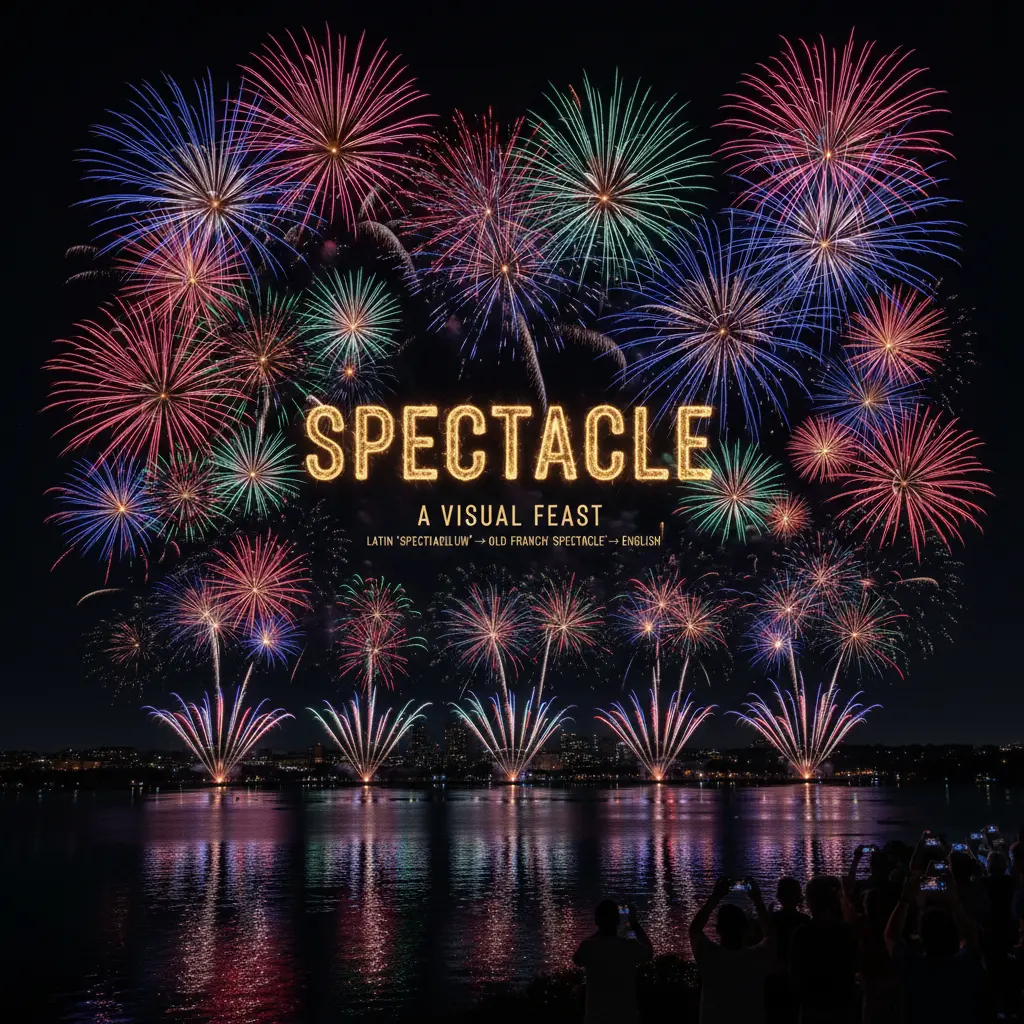
Example sentences are the start of understanding. Don't rush to memorize. First feel how the word works in a sentence.
spectacle = spect- (to look) + -acle (related to) | Latin 'spectaculum' → Old French 'spectacle' → English. Imagine colorful fireworks bursting in the sky, a visual feast that captures everyone's attention, just like a spectacular show.
Note 1: These definitions and etymologies are not standard dictionary definitions, but extended explanations provided to help with memorization and understanding of the actual application of words. Through this background information, we strive to make words more vivid and easier to understand, and help you remember their meanings in real life.
Note 2: LexiTalk designs the learning flow around the linguistics principle of “Comprehensible Input.” When learners encounter material that is slightly above their level but still understandable from context, the brain naturally absorbs the language. That’s why we keep every word inside authentic contexts, using examples and associations to help you understand it and use it flexibly.
Read the FAQ explanation of Comprehensible InputI lean toward the stage, the lights warming up and my eyes learning to focus. I move my head to follow the actors, a steady push and pull of attention. The scene shifts and colors change, and I hold my breath for a beat as a quiet moment lands in the crowd. By the end I feel spectacle isn’t just what I see, but what I decide to feel and remember.
Spectacle is a bold, attention grabbing noun for a visually striking performance, display, or event, often designed to amaze or shock an audience. It can also refer to a pair of eyeglasses, especially when used in phrases like ‘wearing spectacles.’ In everyday use, you might describe a surprising scene, a grand parade, or a nature show as a spectacle, while noting that the word sometimes has a hint of excess or dramatic flourish. Etymologically, spectacle comes from Latin spectaculum, through Old French spectacle, linked to the idea of looking or watching. Learners should distinguish the glasses sense from the grand display by context and articles.
In English, spectacle often centers on dramatic, public displays and events; learners should note that the glasses sense relies on context and plural form 'spectacles'.
What is the meaning of the word 'spectacle'?
Which sentence uses 'spectacle' correctly?
What is a synonym for 'spectacle'?
What is an antonym for 'spectacle'?
How would you use 'spectacle' in a real-life context?
Download LexiTalk app for personalized learning experience
Download AppCookies
We use cookies for essential site functions, analytics, and ads. You can accept, reject, or manage preferences. Privacy Policy