stir - Master This Word
Master this word with our 5-step learning method – Learn English in English
Train English Through Brain Routes, Not Translation.
This page helps you stop memorizing isolated translations and start understanding a word through its shared mental image, native-style thinking, and practical training steps.
Master this word with our 5-step learning method – Learn English in English
Example sentences are the start of understanding. Don't rush to memorize. First feel how the word works in a sentence.
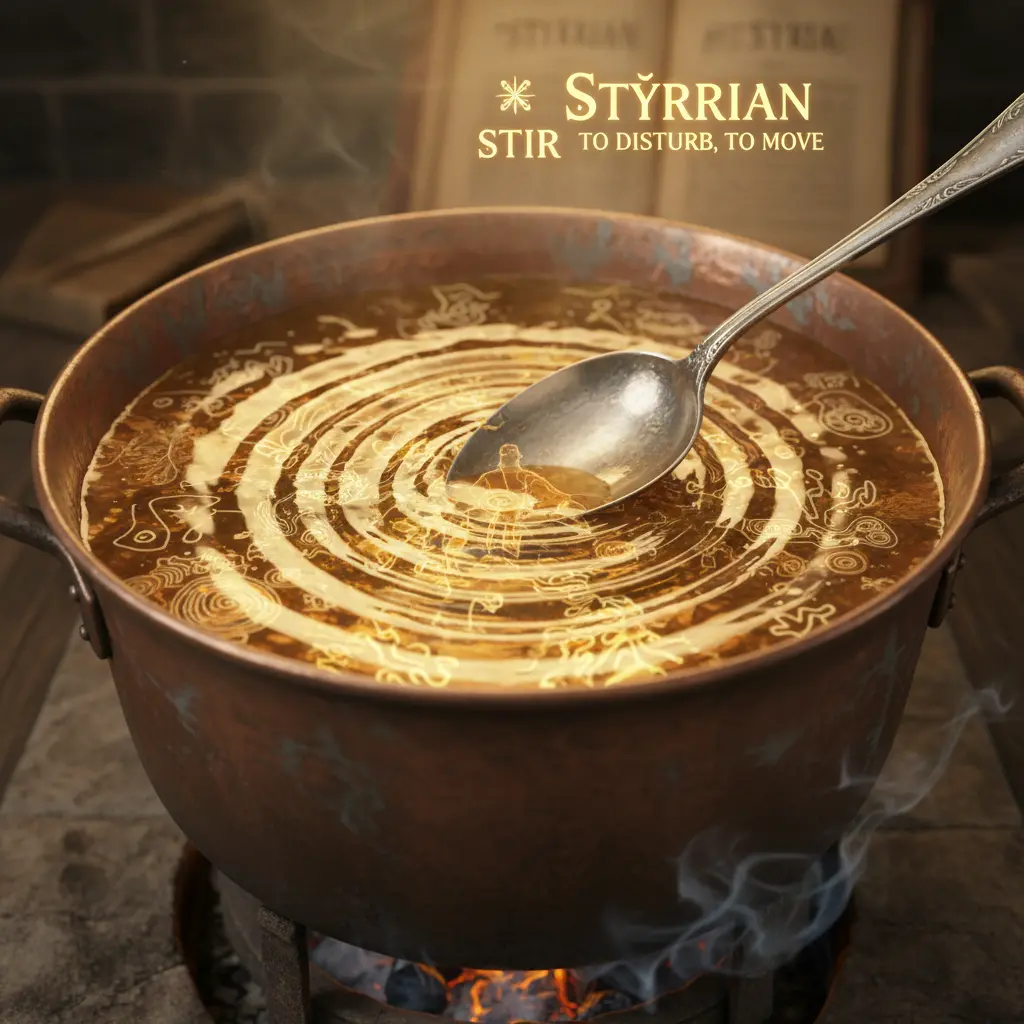
stir comes from the Old English *styrrian, meaning 'to disturb, to move'. Memory image: visualizing a spoon stirring a pot and creating ripples, representing action and change.
Note 1: These definitions and etymologies are not standard dictionary definitions, but extended explanations provided to help with memorization and understanding of the actual application of words. Through this background information, we strive to make words more vivid and easier to understand, and help you remember their meanings in real life.
Note 2: LexiTalk designs the learning flow around the linguistics principle of “Comprehensible Input.” When learners encounter material that is slightly above their level but still understandable from context, the brain naturally absorbs the language. That’s why we keep every word inside authentic contexts, using examples and associations to help you understand it and use it flexibly.
Read the FAQ explanation of Comprehensible InputHands on a spoon, I move it in slow circles, watching the liquid respond. I turn, push, and pull the mixture, adjusting the speed until the surface glides into a smooth swirl. The effort tightens my shoulders a little, and the motion seems to wake flavors or memories. When I stop, I feel ready to act on what comes next, the small stir becoming a cue to start something else.
Stir is a versatile verb that covers both physical and figurative movement. Physically, it means to move a spoon or whisk in a circular motion to blend ingredients or prevent sticking, as in stirring a pot or stirring coffee until it dissolves. Figuratively, stir can awaken feelings or memories, or push people to act, as in stirring curiosity, stirring up memories, or stirring the crowd to take action. The action image of ripples in a pot or a pot of soup becoming evenly mixed helps learners remember the sense of action and change. The Old English root styrrian also hints at disturbance, not merely rotation.
English often treats stir as both a physical action and a catalyst for change, which can surprise learners who expect a single, uniform meaning. Learners may over-generalize to 'move' or 'shake' or forget the 'stir up' and 'stir in' phrasal nuances.
Which sentence uses 'stir' correctly?
What is a similar word to 'stir'?
What is the opposite of 'stir'?
Can you think of a real-life scenario of 'stir'?
Download LexiTalk app for personalized learning experience
Download AppCookies
We use cookies for essential site functions, analytics, and ads. You can accept, reject, or manage preferences. Privacy Policy