supplier - Master This Word
Master this word with our 5-step learning method – Learn English in English
Train English Through Brain Routes, Not Translation.
This page helps you stop memorizing isolated translations and start understanding a word through its shared mental image, native-style thinking, and practical training steps.
Master this word with our 5-step learning method – Learn English in English
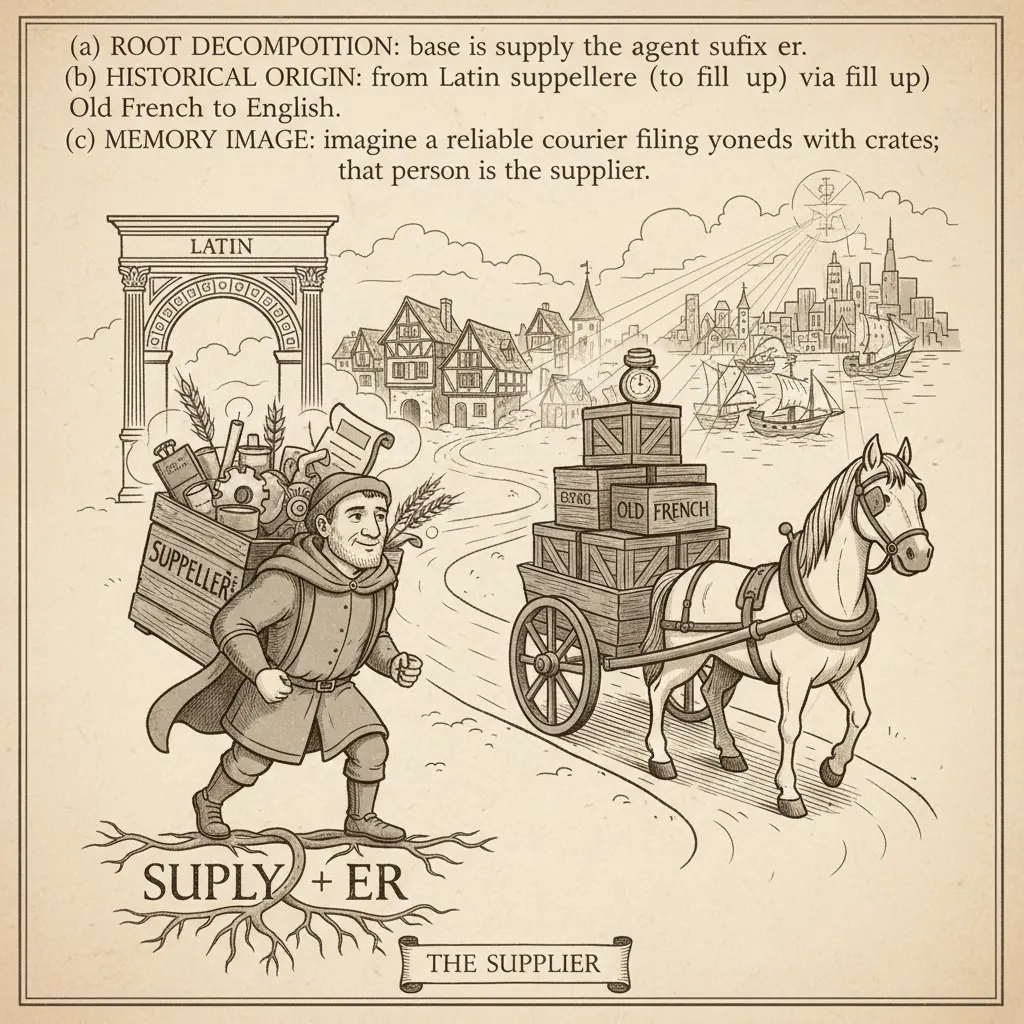
Example sentences are the start of understanding. Don't rush to memorize. First feel how the word works in a sentence.
(a) Root decomposition: base is supply plus the agent suffix er. (b) Historical origin: from Latin suppellere (to fill up) via Old French to English. (c) Memory image: imagine a reliable courier filling your needs with crates; that person is the supplier.
Note 1: These definitions and etymologies are not standard dictionary definitions, but extended explanations provided to help with memorization and understanding of the actual application of words. Through this background information, we strive to make words more vivid and easier to understand, and help you remember their meanings in real life.
Note 2: LexiTalk designs the learning flow around the linguistics principle of “Comprehensible Input.” When learners encounter material that is slightly above their level but still understandable from context, the brain naturally absorbs the language. That’s why we keep every word inside authentic contexts, using examples and associations to help you understand it and use it flexibly.
Read the FAQ explanation of Comprehensible InputA supplier is a person or company that provides goods or services to another, often as part of a business relationship. Suppliers may deliver raw materials, components, or finished products, and they frequently operate under contracts that specify price, quality, and delivery timelines. The term is common in procurement, logistics, and manufacturing, and it can describe a single vendor or an entire network in a supply chain. Etymology traces to supply + er, with Latin suppellere and Old French influence on English. In everyday English you’ll hear phrases like 'preferred supplier', 'supplier invoice', or 'supplier base' to describe the source you rely on. Figuratively, someone who constantly provides resources can be called a supplier of ideas or energy.
This explains supplier as a formal source in business terms; learners often mix up supplier with seller or confuse internal vs external providers.
What is the meaning of 'supplier'?
In which sentence is 'supplier' used correctly?
What is a synonym for 'supplier'?
What is an antonym for 'supplier'?
How does the concept of 'supplier' apply in real-world situations?
Download LexiTalk app for personalized learning experience
Download AppCookies
We use cookies for essential site functions, analytics, and ads. You can accept, reject, or manage preferences. Privacy Policy