them - Master This Word
Master this word with our 5-step learning method – Learn English in English
Train English Through Brain Routes, Not Translation.
This page helps you stop memorizing isolated translations and start understanding a word through its shared mental image, native-style thinking, and practical training steps.
Master this word with our 5-step learning method – Learn English in English
Example sentences are the start of understanding. Don't rush to memorize. First feel how the word works in a sentence.
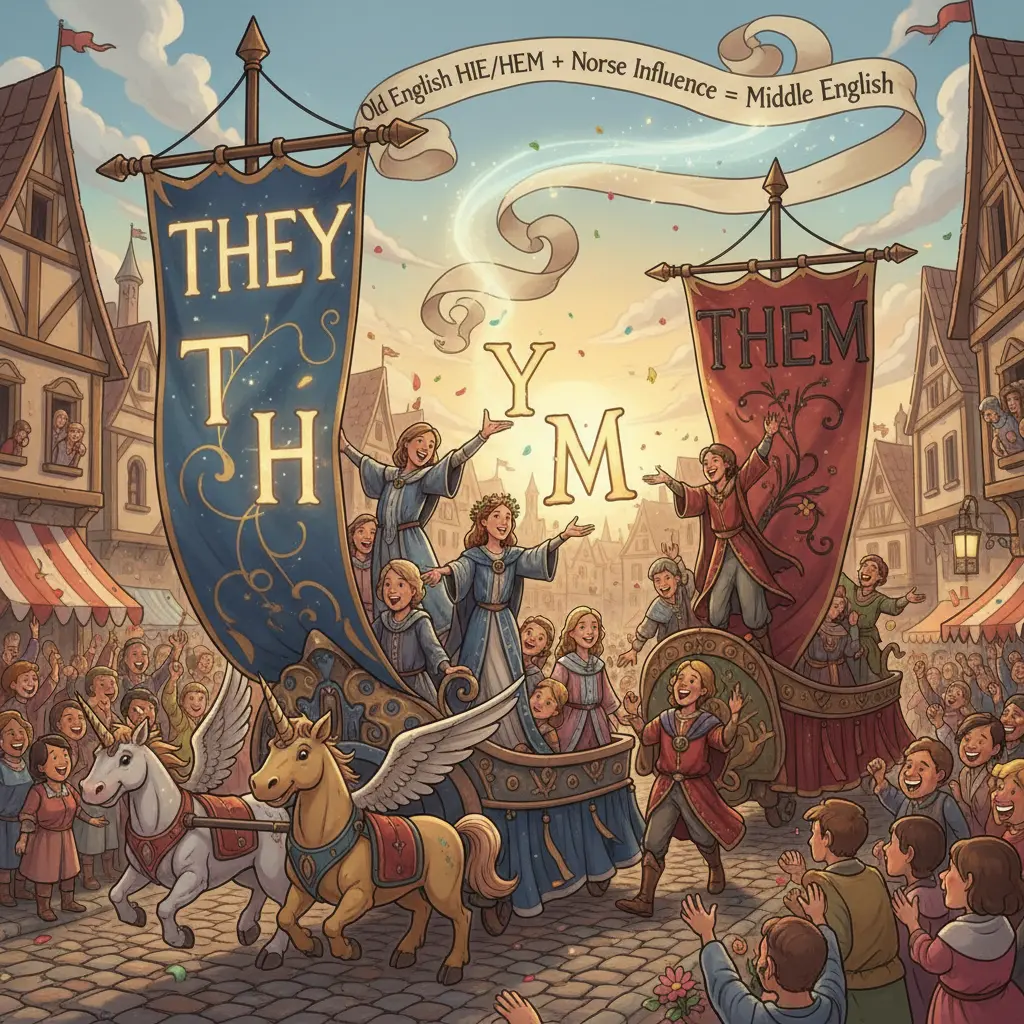
Root decomposition: base pronoun they plus an oblique-case adjustment yields the object form them. Historical origin: from Old English hie/hem with Norse influence; the oblique form hem evolved into them in Middle English. Memory image: imagine a parade called THEY handing the letter M to THEM.
Note 1: These definitions and etymologies are not standard dictionary definitions, but extended explanations provided to help with memorization and understanding of the actual application of words. Through this background information, we strive to make words more vivid and easier to understand, and help you remember their meanings in real life.
Note 2: LexiTalk designs the learning flow around the linguistics principle of “Comprehensible Input.” When learners encounter material that is slightly above their level but still understandable from context, the brain naturally absorbs the language. That’s why we keep every word inside authentic contexts, using examples and associations to help you understand it and use it flexibly.
Read the FAQ explanation of Comprehensible InputFirst I shift my weight and turn toward the group. I ease into a calm stance and keep my gaze on them as the room settles. The effort shows in my hands as I adjust the rhythm of my breath, letting the moment breathe through the talk. In that small turn, 'them' stops being just a word and becomes the living people here, whom I refer to with care in conversation.
Them is the standard object form of they, used for both plural groups and, increasingly, a single person whose gender is unknown or nonbinary. You can say 'I saw them' about multiple people, or 'I gave the book to them' in neutral contexts. In everyday speech, 'they' as a subject pronoun now has a singular, gender-neutral form, and the corresponding object form remains 'them'. 'Leave them alone' uses them as a generic referent for people in general, not just a specific group. Remember that 'them' can replace masculine or feminine pronouns when the gender is unspecified or irrelevant, and be aware that prescriptive rules vary by community.
Most English learners map they/them directly to people in gendered terms, so the shift to singular they/them can feel new and liberating but also confusing if learners hold binary expectations. In many languages, there is a distinct plural form that differs from a single-person usage, whichtrips learners who try to force a plural form onto a singular referent.
What is the meaning of the word 'them'?
How is the word 'them' used in a sentence?
Which word is similar to 'them'?
What is the opposite of 'them'?
In what context would you use the word 'them'?
Download LexiTalk app for personalized learning experience
Download AppCookies
We use cookies for essential site functions, analytics, and ads. You can accept, reject, or manage preferences. Privacy Policy