
warfare - Master This Word
Master this word with our 5-step learning method – Learn English in English
Train English Through Brain Routes, Not Translation.
This page helps you stop memorizing isolated translations and start understanding a word through its shared mental image, native-style thinking, and practical training steps.
Master this word with our 5-step learning method – Learn English in English
Example sentences are the start of understanding. Don't rush to memorize. First feel how the word works in a sentence.
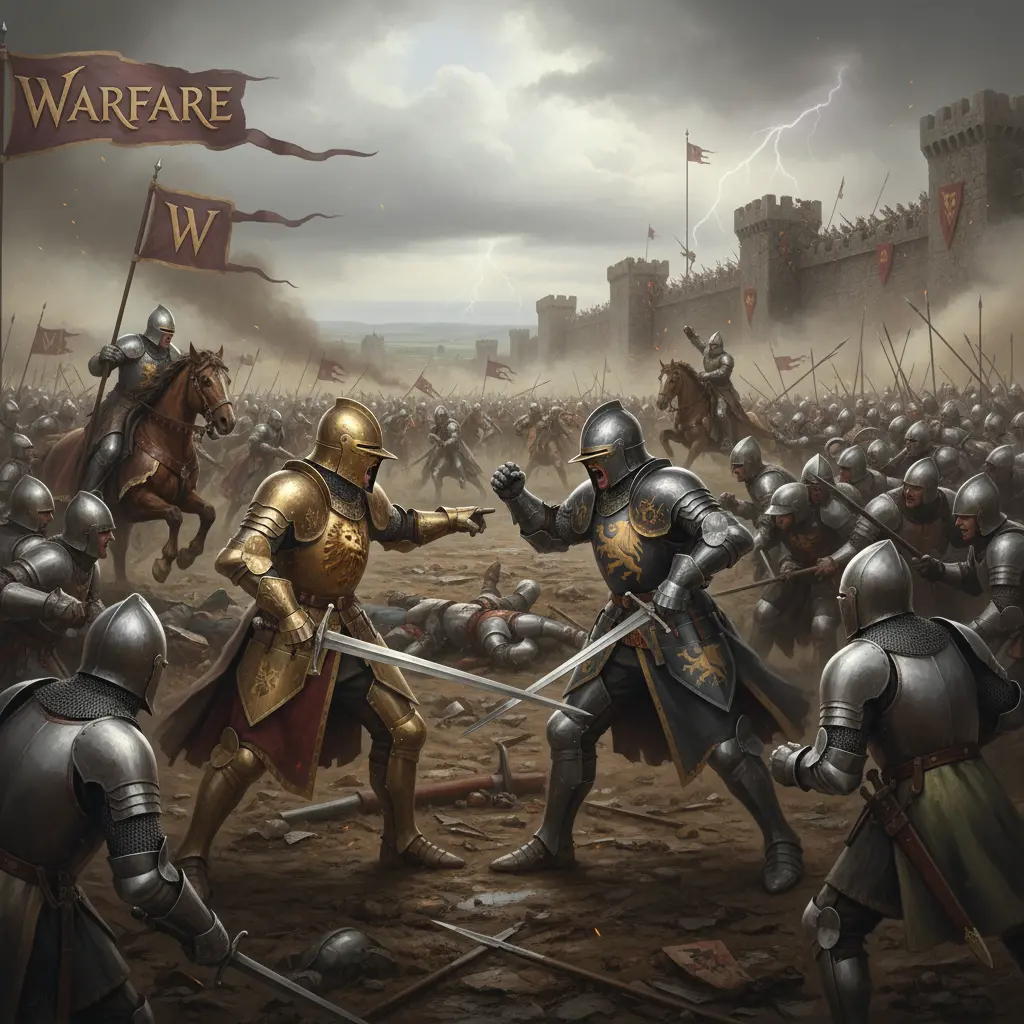
warfare: war (conflict) + fare (to carry out); from Old English 'werre' + 'fare' (to journey). Imagine knights clashing in a battlefield, commanding troops to carry on the battle.
Note 1: These definitions and etymologies are not standard dictionary definitions, but extended explanations provided to help with memorization and understanding of the actual application of words. Through this background information, we strive to make words more vivid and easier to understand, and help you remember their meanings in real life.
Note 2: LexiTalk designs the learning flow around the linguistics principle of “Comprehensible Input.” When learners encounter material that is slightly above their level but still understandable from context, the brain naturally absorbs the language. That’s why we keep every word inside authentic contexts, using examples and associations to help you understand it and use it flexibly.
Read the FAQ explanation of Comprehensible InputI lean over the game board and move a tiny fortress with a steady press of my finger. I shift my weight to keep the pieces aligned as the lines of attack change in front of me. I push a line of pawns, then pull back to hold a fragile defense, feeling the pressure tighten my chest. The moment reveals itself not as a definition but as a field of decisions, the word warfare quietly taking shape through effort and choice.
Warfare is the broad set of activities involved in armed conflict, from strategy and logistics to violence and diplomacy. It encompasses not just the fighting itself but the preparation, technology, and social effects that accompany war. The word can refer to specific campaigns or to the general state of armed contention between nations or groups within a country. In everyday use, warfare often implies organized, sustained hostility rather than a single battle. Learners should note the collocations: conduct warfare, wage warfare, or be at war; warfare contrasts with war as a period of fighting, and with fighting or combat as individual acts.
Warfare in English often emphasizes process, scope, and organization, which can be hard for learners who think 'war' is a single event. People may overgeneralize or underuse formal terms like 'conduct warfare' and 'wage warfare'.
What is the meaning of 'warfare'?
Which sentence uses 'warfare' correctly?
Which word is most similar to 'warfare'?
What is the opposite of 'warfare'?
Can you think of a real-life scenario involving intense military conflict?
Download LexiTalk app for personalized learning experience
Download AppCookies
We use cookies for essential site functions, analytics, and ads. You can accept, reject, or manage preferences. Privacy Policy