fanfare - Master This Word
Master this word with our 5-step learning method – Learn English in English
Train English Through Brain Routes, Not Translation.
This page helps you stop memorizing isolated translations and start understanding a word through its shared mental image, native-style thinking, and practical training steps.
Master this word with our 5-step learning method – Learn English in English
Example sentences are the start of understanding. Don't rush to memorize. First feel how the word works in a sentence.
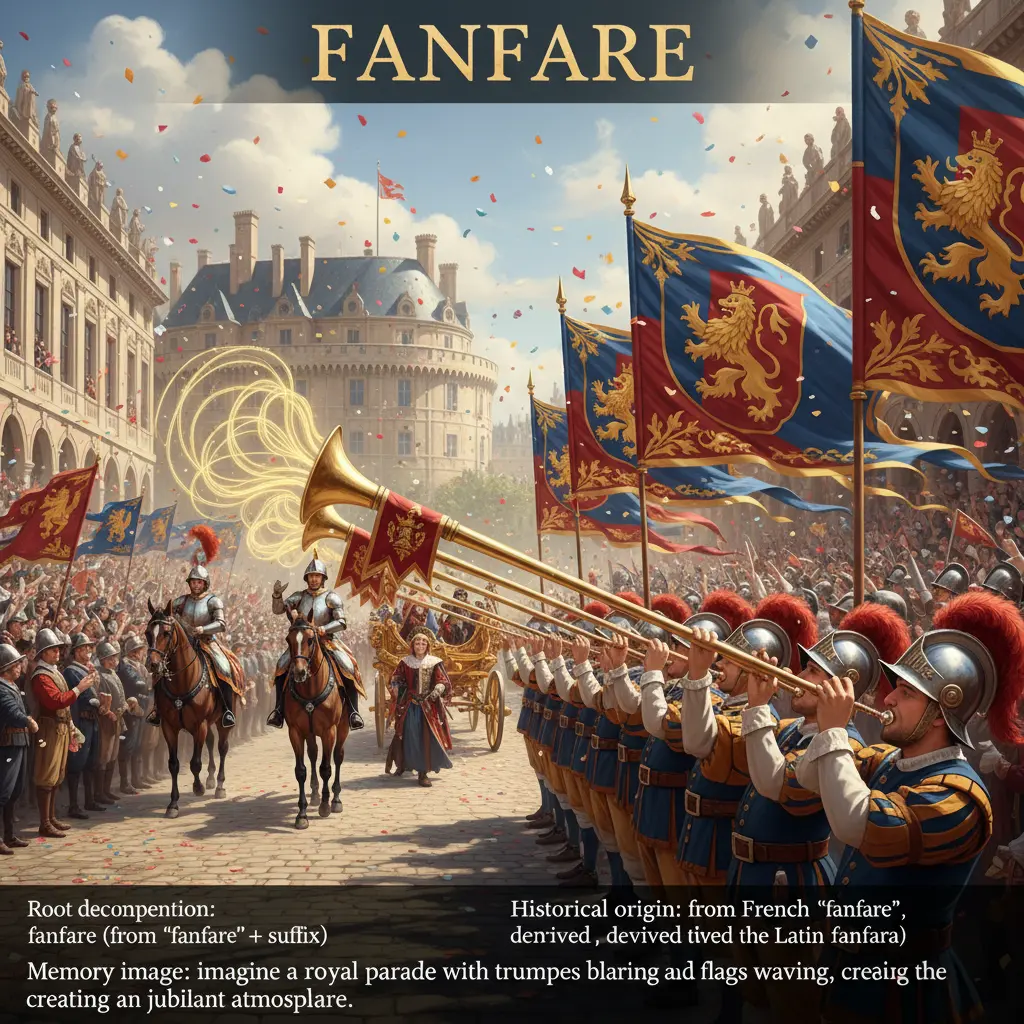
Root decomposition: fanfare (from 'fanfare' + suffix); Historical origin: from French 'fanfare', derived from the Latin 'fanfara'; Memory image: imagine a royal parade with trumpets blaring and flags waving, creating a jubilant atmosphere.
Note 1: These definitions and etymologies are not standard dictionary definitions, but extended explanations provided to help with memorization and understanding of the actual application of words. Through this background information, we strive to make words more vivid and easier to understand, and help you remember their meanings in real life.
Note 2: LexiTalk designs the learning flow around the linguistics principle of “Comprehensible Input.” When learners encounter material that is slightly above their level but still understandable from context, the brain naturally absorbs the language. That’s why we keep every word inside authentic contexts, using examples and associations to help you understand it and use it flexibly.
Read the FAQ explanation of Comprehensible InputFanfare is a word with three linked senses. It can describe a brief ceremonial tune played on brass instruments at parades, official openings, or grand arrivals. It also denotes a showy display or announcement designed to attract attention, sometimes with a sense of self-importance rather than substance. Finally, it can refer to a public celebration marked by excitement and noise, often featuring loud media coverage or crowds. The etymology points to a French origin and ultimately Latin roots, evoking the image of trumpets and banners signaling something noteworthy. Learners should distinguish the musical cue from the broader flashy spectacle and from a plain celebration.
English speakers often picture fanfare as both a music cue and a flashy event, with a stronger sense of ceremony than casual excitement. Learners may overgeneralize it to mean any hype or celebration and confuse the noun with adjectives like hype or spectacle.
What is the definition of 'fanfare'?
Choose the correct usage of the word 'fanfare' in a sentence.
Which word is most similar to 'fanfare'?
What is the opposite of 'fanfare'?
Can you provide a real-life context where someone might use 'fanfare'?
Download LexiTalk app for personalized learning experience
Download AppCookies
We use cookies for essential site functions, analytics, and ads. You can accept, reject, or manage preferences. Privacy Policy