gravity - Master This Word
Master this word with our 5-step learning method – Learn English in English
Train English Through Brain Routes, Not Translation.
This page helps you stop memorizing isolated translations and start understanding a word through its shared mental image, native-style thinking, and practical training steps.
Master this word with our 5-step learning method – Learn English in English
Example sentences are the start of understanding. Don't rush to memorize. First feel how the word works in a sentence.
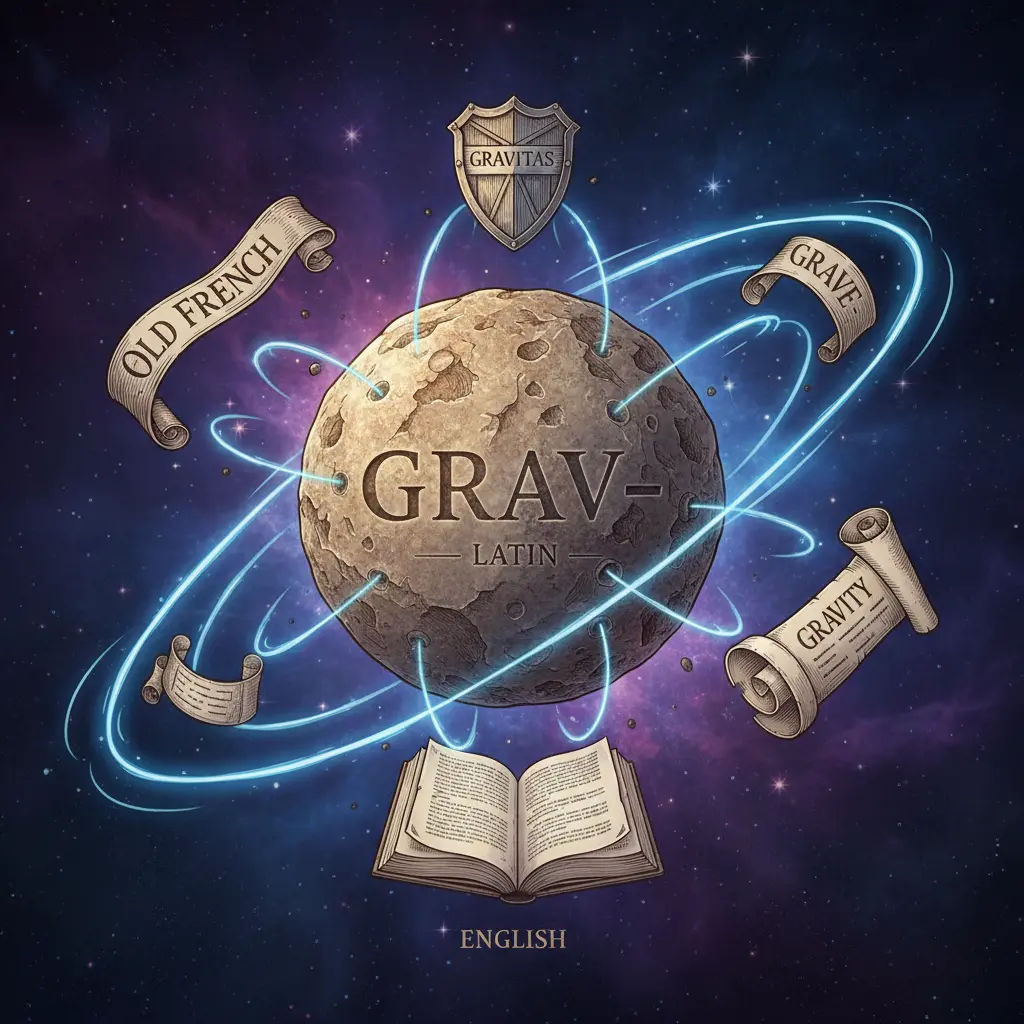
Root: grav- = heavy; Historical origin: Latin → Old French → English. Memory image: Imagine a heavy object pulling everything towards it like a magnet, illustrating the concept of gravity.
Note 1: These definitions and etymologies are not standard dictionary definitions, but extended explanations provided to help with memorization and understanding of the actual application of words. Through this background information, we strive to make words more vivid and easier to understand, and help you remember their meanings in real life.
Note 2: LexiTalk designs the learning flow around the linguistics principle of “Comprehensible Input.” When learners encounter material that is slightly above their level but still understandable from context, the brain naturally absorbs the language. That’s why we keep every word inside authentic contexts, using examples and associations to help you understand it and use it flexibly.
Read the FAQ explanation of Comprehensible InputI pick up a mug and set it on the edge of the counter, then let it go. Gravity begins to pull it downward as the cup gathers speed, and I adjust my grip to slow the fall. I feel the weight, the small fight to keep control, and I smile at the balance. Later, I use the same pull to decide where to place objects so they stay steady, not slide away.
Gravity is a fundamental physical force that attracts every mass toward the center of the Earth (and, more broadly, toward any massive body). In everyday English, gravity also appears as a metaphor for seriousness or importance, as in 'the gravity of the situation.' The word comes from grav- meaning heavy, tracing from Latin through Old French into English. A vivid memory image is a heavy object pulling everything toward the ground, which helps you connect the science sense with the figurative sense of dignity or solemnity. Mastery comes from recognizing both senses and knowing common collocations like gravitational force, weight, and weightless.
English learners often assume gravity only means heaviness or weight, and miss its idiomatic use about seriousness. They may also confuse gravity with gravitation as a noun vs verb form, or overgeneralize the phrase gravity to any mood.
What is the meaning of the word 'gravity'?
Which sentence uses the word 'gravity' correctly?
Which word is most similar to 'gravity'?
What is the opposite of 'gravity'?
Can you give an example of a real-life scenario involving 'gravity'?
Download LexiTalk app for personalized learning experience
Download AppCookies
We use cookies for essential site functions, analytics, and ads. You can accept, reject, or manage preferences. Privacy Policy