tolerate - Master This Word
Master this word with our 5-step learning method – Learn English in English
Train English Through Brain Routes, Not Translation.
This page helps you stop memorizing isolated translations and start understanding a word through its shared mental image, native-style thinking, and practical training steps.
Master this word with our 5-step learning method – Learn English in English
Example sentences are the start of understanding. Don't rush to memorize. First feel how the word works in a sentence.
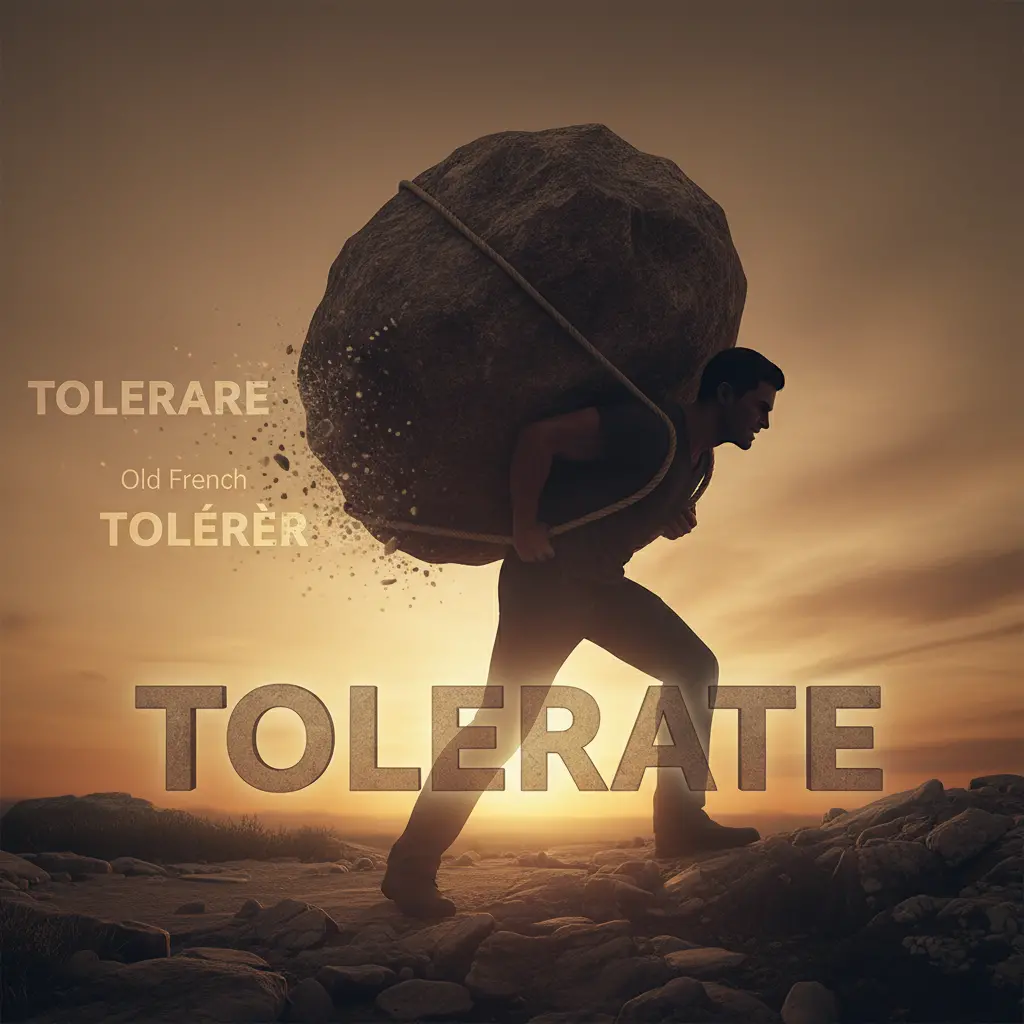
Root decomposition: 'toler-' = to bear, 'ate' = to make. Historical origin: Latin 'tolerare' → Old French 'tolérer' → English. Memory image: Imagine someone carrying a heavy load, choosing to bear it instead of dropping it, signifying endurance and acceptance.
Note 1: These definitions and etymologies are not standard dictionary definitions, but extended explanations provided to help with memorization and understanding of the actual application of words. Through this background information, we strive to make words more vivid and easier to understand, and help you remember their meanings in real life.
Note 2: LexiTalk designs the learning flow around the linguistics principle of “Comprehensible Input.” When learners encounter material that is slightly above their level but still understandable from context, the brain naturally absorbs the language. That’s why we keep every word inside authentic contexts, using examples and associations to help you understand it and use it flexibly.
Read the FAQ explanation of Comprehensible InputFirst I shift my posture, feet planted and hands steady on the desk, as a loud buzz in the room pushes at my attention. I tighten and release my jaw, adjust my breathing, and pull the noise into the background until I can read. The moment changes from irritation to focus, and I keep going, letting the experience stretch without breaking. By the end I realize I can tolerate the sound because I chose to stay present, not to fight it.
tolerate means to endure or accept something unpleasant without joy, and to permit something to happen despite disapproval. It often describes a situation, person, or behavior you don’t like but can bear for a reason. You might tolerate a noisy neighbor, a slow internet connection, or a policy that allows a certain exception. The nuance sits between endure and allow: tolerate conveys bearing with something rather than enjoying it, or simply deciding to permit it to continue. Grammatically, tolerate is followed by a noun, a gerund, or a that-clause (tolerate that...). Memory cue: imagine carrying a heavy load and choosing to bear it rather than drop it, a sign of endurance and acceptance.
For English learners, tolerate sits between endure and permit. It emphasizes bearing with something negative, not enjoying it, and often signals a boundary with 'can't' or 'won't'.
What is the meaning of 'tolerate'?
Which sentence uses 'tolerate' correctly?
What is a synonym for 'tolerate'?
What is an antonym for 'tolerate'?
How would you use 'tolerate' in a real-life situation?
Download LexiTalk app for personalized learning experience
Download AppCookies
We use cookies for essential site functions, analytics, and ads. You can accept, reject, or manage preferences. Privacy Policy